
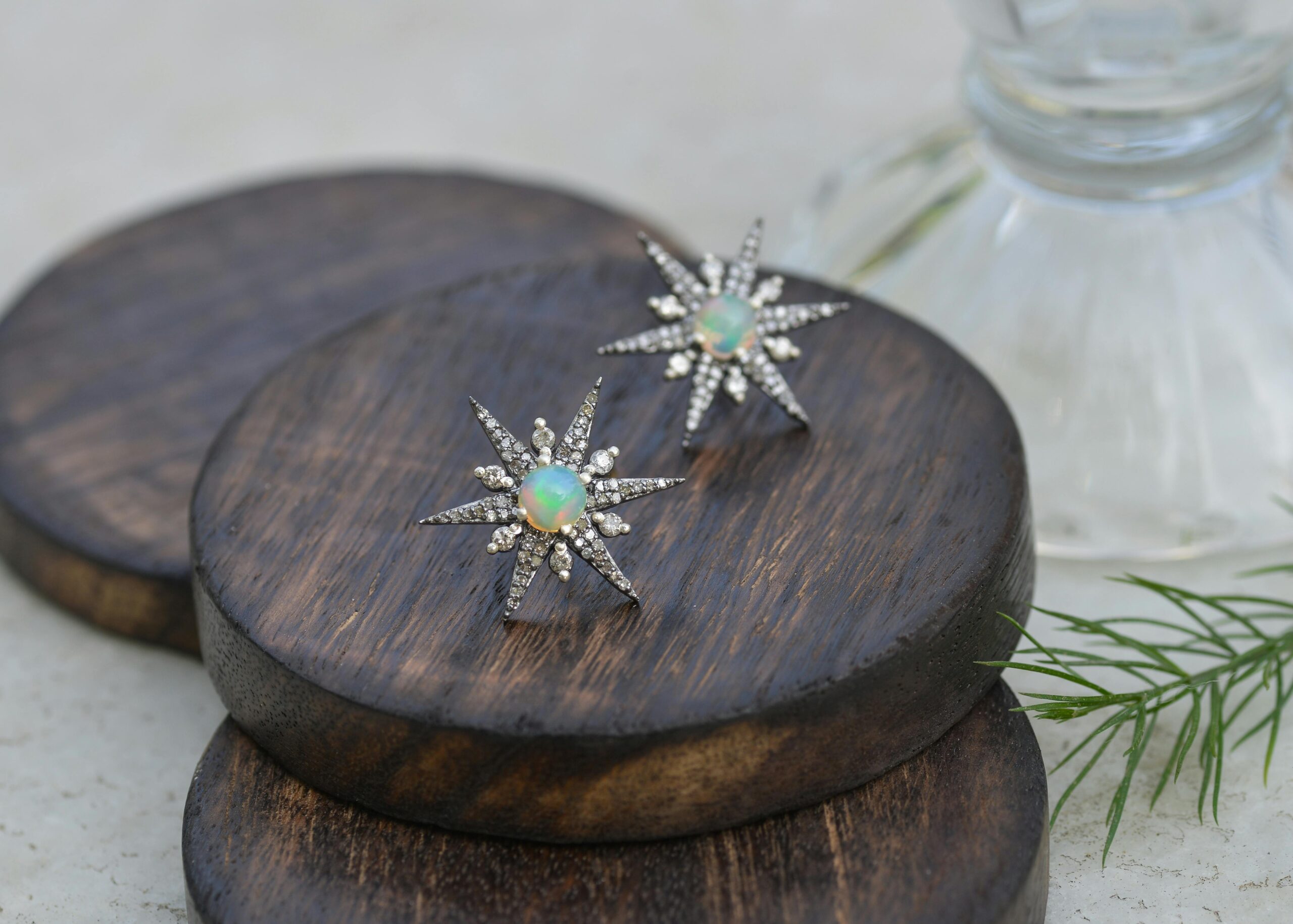
Opal jewelry has captivated admirers for centuries with its kaleidoscopic play-of-color and mystical charm. From enchanting opal engagement rings to delicate opal necklaces, this gemstone offers a unique appeal for those seeking something truly special.
In this comprehensive guide, we’ll explore what makes opals so mesmerizing, the various types of opals, popular styles (like vintage rings and modern opal rings with diamonds), metal settings (from classic gold to trendy rose gold), as well as practical advice on buying and caring for your opal jewels.
Whether you’re considering a fire opal engagement ring, a blue opal pendant, or simply want to learn more about this October birthstone, read on – opals might just cast their colorful spell on you.
Contents
- 1 What Is Opal? Understanding the Gemstone’s Allure
- 2 Types of Opals: From Black Opal to Fire Opal
- 3 Opal Engagement Rings: Unique Beauty with Special Considerations
- 4 Beyond Rings: Opal Necklaces, Earrings, and More
- 5 Metal Choices and Complementary Stones for Opal Jewelry
- 6 Shopping Tips: Finding Quality Opal Jewelry Online and In-Store
- 7 Caring for Your Opal Jewelry
- 8 Conclusion: Embracing the Magic of Opal
What Is Opal? Understanding the Gemstone’s Allure
Opal is a one-of-a-kind gemstone known for its iridescent “play-of-color” – a phenomenon where flashes of rainbow hues dance across the stone’s surface as it catches the light. Unlike most gems which are crystalline minerals, opal is classified as a mineraloid: it’s formed from silica gel that hardened without a crystalline structure.
In simple terms, opal is composed of tiny silica spheres bonded with water; in fact, opal can contain up to 3–21% water by weight (usually around 6–10%). This unique makeup gives opal its distinctive visual effects – and also means it needs a bit of special care (more on that later).
Some key characteristics of opal include:
- Hardness: Opal ranks about 5.5–6.5 on the Mohs hardness scale, which is softer than many popular gems like quartz or diamond. This means opal can scratch or chip more easily, so opal jewelry is best worn with mindfulness of its fragility.
- Luster and appearance: Most gem-quality opals are cut as smooth domes (cabochons) rather than faceted, to best display their color flashes. They have a glossy, waxy luster and can be transparent, translucent, or opaque, with body colors ranging from colorless or white to black, and every hue in between.
- Play-of-color: Only precious opal exhibits the famous multicolor flashes. Common opal (sometimes called “potch”) has the same chemical makeup but lacks this play-of-color, appearing more uniform. Precious opal’s internal silica structure diffracts light like a tiny prism, splitting it into various colors. The result has been poetically described since ancient times – the Roman scholar Pliny compared opal’s colors to “the fire of ruby, the purple of amethyst, the sea-green of emerald, all glittering together”.
Origin & sources: Opal is found in several parts of the world, but Australia is the leading source, producing an estimated 90% of the world’s opals. It’s no surprise that opal is Australia’s national gemstone. Famous Australian opal fields (like Lightning Ridge for black opals and Coober Pedy for white opals) have produced many legendary stones.
Other significant sources include Ethiopia (notably Welo opals with vivid play-of-color), Mexico (fire opals with bright orange-red hues), Brazil, Peru (known for blue and pink common opals), and the United States (such as Nevada’s Virgin Valley fire opals). Each locale yields opals with their own character, from the transparent Mexican fire opal to the crystal opals of Ethiopia.
Birthstone & symbolism: Opal is the traditional birthstone for October, sharing that honor with tourmaline. As a birthstone, opal is said to symbolize purity, hope, and truth, and to bring its wearer good fortune and inner peace. Throughout history, opal has carried a rich lore. Many cultures have cherished it as a lucky talisman: ancient Romans saw opal as a symbol of hope and love, and Arabs once imagined opals fell from the sky in bolts of lightning.
European traditions considered opal a stone of hope, purity, and truth. However, opal’s reputation took a dip in the 19th century due to a literary superstition – a character in Sir Walter Scott’s 1829 novel Anne of Geierstein wore an opal that was misinterpreted to cause misfortune.
This fictional tale sparked rumors that opals bring bad luck. In reality, this is just myth: for ages opal was regarded as one of the luckiest and most magical of gems. Modern enthusiasts fully embrace opal’s positive qualities and mesmerizing beauty.
Types of Opals: From Black Opal to Fire Opal
Not all opals look the same. In fact, opals come in a dazzling variety of types, each with its own distinctive appearance. Here’s a rundown of the most notable types of opal you might encounter in jewelry:
- White Opal: Also called light opal, this has a white, milky or light-gray body color. It often displays pastel flashes of color against the pale background. White opal is one of the most common precious opals (many Australian opals are white opals). It offers a soft, diffuse kind of beauty – think of a cloudy sky lit up by a rainbow.
- Black Opal: The most valued type, black opal has a dark body tone (dark gray to jet black) which makes its play-of-color appear especially vivid and dramatic. Black opal is considered the rarest and most coveted opal. The contrast of neon greens, fiery reds, and electric blues against a black background can be breathtaking.
Lightning Ridge in Australia is famed for producing high-quality black opals, though some dark-base opals also come from other locales (even Welo opals in Ethiopia can have dark body). Despite the name, a “black opal” need not be true black – just any opal with a darker base qualifies. - Boulder Opal: Found mainly in Queensland, Australia, boulder opal forms as thin veins within a brown ironstone rock. Boulder opals are usually cut leaving some of the host rock on the back, which acts as a natural backing. This type often has irregular, free-form shapes. The mix of chocolate-brown matrix with brilliant opal streaks gives boulder opal a rustic, earthy charm and each piece is truly unique.
- Fire Opal: Unlike other opals, fire opal is prized more for its vibrant body color than for play-of-color. Fire opals are typically transparent to translucent with a bright orange, red or yellow base – hence the “fire” name.
They may or may not display internal flashes (and if they do, it’s usually small sparkles of green). High-quality fire opals often come from Mexico, so you might see them called Mexican fire opal. These stones are sometimes faceted because of their clarity. A fire opal engagement ring can be a bold choice, with its warm fiery glow symbolizing passion. - Crystal Opal: This term refers to opals with a transparent or semi-transparent body (sometimes also called “water opal” when very clear). Crystal opals can be almost glass-like in clarity, which allows you to see deep into the stone. When a crystal opal displays play-of-color, the flashes can appear suspended in the stone like a hologram – often incredibly beautiful. Crystal opals may have a white or dark base but are distinguished by their clarity.
- Blue Opal: Often when people mention blue opal jewelry, they are referring to the blue-colored common opal found in Peru (Peruvian blue opal). These Peruvian opals have a soft blue-green color reminiscent of tropical waters, usually without play-of-color (they are a type of common opal). They make lovely cabochons or beads and are popular in artisan jewelry.
Some treated or synthetic opals also exhibit a predominantly blue color, but natural blue opal from Peru has an opaque, soothing blue appearance. Blue opal jewelry offers a calming, cool-toned alternative to the fiery flashes of precious opals. - Ethiopian Opal: A modern find (Ethiopia began producing opal in large quantities in the 2000s), Ethiopian opal—especially from the Welo region—often comes as vivid translucent opals with play-of-color. These can rival Australian opals in beauty, displaying broad flashes of neon color.
One special property of some Ethiopian opals is that they are hydrophane, meaning they can absorb water. When soaked, they can temporarily lose some opacity or change appearance, and revert once dry. This property means Ethiopian opals (and any hydrophane opal) should be kept away from water to avoid temporary changes or potential damage. - Pink Opal, Green Opal & Other Common Opals: Opal can basically occur in any color. Common opals that have pleasing body colors (even without play-of-color) are used in jewelry – for example, opaque pastel pink opals from Peru/Andes, or green opal (which might be a trade name for certain common opal with a green hue). These stones don’t flash rainbow colors, but their attractive hues and relative affordability make them popular for beads, cabochons and decorative pieces.
In addition to natural opal varieties, the jewelry market also features treated and synthetic opals: – Doublets and Triplets: These are assembled opals made to affordably mimic the look of a solid top-quality opal. An opal doublet consists of a thin slice of precious opal glued onto a dark backing (often black glass or ironstone) to imitate a natural black opal.
An opal triplet goes a step further: it has a thin opal layer, a dark backing, and then a clear domed cap (quartz or resin) on top for protection. The cap of a triplet also magnifies the color play, making the thin opal slice appear more vibrant. Doublets and triplets are more affordable than solid opals and can be quite beautiful, but they contain only a small amount of real opal.
They require careful handling (water or heat can sometimes weaken the glue bond and cause clouding or separation of layers). If you own such pieces, avoid long exposure to water – solid opals are fine getting wet, but doublets/triplets can be damaged by water infiltration. – Lab-Created Opal: Scientists have learned to grow opals in a laboratory, a process perfected in the 1970s.
Synthetic opals have the same chemical composition as natural opal and often exhibit brilliant play-of-color. They can be spotted by their pattern – lab opals might show a “snake-skin” or too-perfect periodic color patchwork.
They’re an ethical and budget-friendly option for those who want the look of opal without the higher cost. Always buy from reputable sources that disclose treatments or lab-grown origin of opals so you know if your opal is natural or not.
Now that we know the types of opals, let’s delve into how opal is used in jewelry – especially in that most symbolic of jewels, the engagement ring.
Opal Engagement Rings: Unique Beauty with Special Considerations
Opal engagement rings have become a popular choice for those who want something beyond the traditional diamond. There’s no denying the allure of an opal’s shifting colors on one’s finger – it’s like wearing a miniature galaxy or rainbow that changes with every movement.
Opal rings, especially as engagement or promise rings, appeal to free-spirited and romantic souls who appreciate the gem’s individuality (no two opals are ever identical!). An opal center stone paired with a meaningful design can make for a deeply personal ring.
That said, choosing an opal for a ring that’s worn daily (like an engagement or wedding ring) does require some careful thought. Opal is softer and more delicate than traditional engagement ring stones (like diamonds, sapphires, or rubies). Let’s break down the pros, cons, and popular styles of opal engagement rings:
Why Choose an Opal Engagement Ring?
- Exceptional Beauty: Opal offers a kind of beauty that no other gemstone can match. The play-of-color can resemble a cosmic nebula or a fireworks display. Many brides are drawn to opal’s almost mystical appearance – an opal engagement ring with diamonds around it, for example, can look like a halo of rainbow fire. The gemstone’s color flashes can even symbolize the many facets of one’s love. Opals also photograph stunningly, making for great ring shots!
- Uniqueness: Opal rings are inherently unique. Even if someone else also has an opal, the patterns and colors in each stone will differ. If you love vintage styles, opal ring vintage designs (like Edwardian or Art Deco opal rings) have a classic charm that sets you apart from the crowd of diamond solitaires.
- Symbolism and Personal Meaning: Opal’s symbolism of hope, love, and creativity can imbue an engagement ring with personal significance. Some choose opal because it’s their partner’s birthstone (October), or because the stone is believed to inspire loyalty and passion. In some legends, opal was considered a symbol of fidelity and assurance. Opal wedding rings meaning can be special to the couple – for instance, a black opal engagement ring might represent a rare and deep love (as rare as the gem itself), while a fire opal ring could symbolize a burning passion.
- Affordability (Sometimes): While top-grade opals can be very expensive, many opal engagement rings are more affordable than diamond ones of similar size. You can find beautiful opal rings at various price points – from natural opal engagement rings in artisan silver settings for a few hundred dollars, to high-end black opals surrounded by diamonds in 18k gold costing thousands. There’s flexibility to suit different budgets.
Important Considerations (Pros & Cons):
- Softness and Durability: The biggest concern with opal as an engagement stone is durability. With a Mohs hardness around 5.5–6, opal is significantly softer than diamonds (10) or sapphires (9). This means an opal ring can scratch, chip, or crack if accidentally knocked against hard surfaces.
Daily wear exposes a ring to lots of bumping and possibly hand contact with objects, so an opal engagement ring is at higher risk of damage than a harder stone would be. In fact, some jewelers outright caution against opals for everyday rings for this reason.
If you or your partner lead a very active lifestyle or do a lot of hands-on work, consider whether you’re prepared to baby an opal ring. You may choose to wear it only on special occasions or ensure it has a protective setting (like a bezel that surrounds the stone). - Sensitivity (Heat and Dryness): Opals can be sensitive to sudden temperature changes and very dry conditions. Because opal contains water, excessive heat or extremely low humidity can cause the gem to lose moisture and develop tiny cracks (“crazing”).
While this is not common in well-hardened opals, it’s something to be mindful of. For example, it’s wise to take off an opal ring before activities like baking in a hot oven or going from a sauna to a cold pool.
Likewise, storing an opal ring long-term in a very dry environment (like a hot safe) could potentially dry it out; some people keep a small damp cotton ball near opals in storage to maintain humidity. On the flip side, too much water exposure can harm opals as well – porous opals or doublets/triplets can absorb water and become cloudy.
You should avoid submerging opal jewelry in water for long (no wearing opal rings while swimming or doing dishes) to prevent any moisture issues, especially for composite opals. - Maintenance: Opal rings require gentle care. You cannot use ultrasonic cleaners or steam cleaners on opal pieces – the intense vibrations or heat can crack the stone. Cleaning should be done with mild soap, warm water, and a soft cloth.
Also, opals should be stored separately from harder gems to prevent scratching (a diamond in the same jewelry box can easily scratch an opal). We’ll provide detailed care tips in a later section, but suffice to say an opal engagement ring needs a bit more TLC than a diamond ring would. - Alternatives for Daily Wear: If you love opals but worry about daily wear, one compromise is to have an opal engagement ring set where you wear a simpler, durable band day-to-day (like a plain gold wedding band or a diamond band), and wear your opal ring on special occasions.
Another option: use opal as an accent stone instead of the main center (for example, a ring with small opal inlays or side stones can add opal’s color without putting a large opal at risk). Some couples also opt for opal doublets/triplets or synthetic opals for engagement-style rings – the quartz cap on a triplet can offer some protection, and if it does get damaged or scratched, it’s less costly to replace than a top-quality natural opal. Ultimately, it’s a personal choice weighed between aesthetic desire and practical lifestyle.
Popular Styles of Opal Engagement Rings:
Opal’s versatile beauty means it can suit a range of ring styles, from modern minimalist to antique vintage. Here are a few sought-after looks:
- Vintage & Antique Designs: Opal engagement rings vintage style are quite popular – opals were especially beloved in the late 19th century (Victorian era) and early 20th century. An antique opal ring might feature an oval cabochon opal in a yellow gold setting with intricate engraving or milgrain detail. Victorian opal rings often paired opals with other gems like diamonds or seed pearls.
Choosing a vintage opal ring (or a modern reproduction of one) gives your engagement ring a romantic, heirloom vibe. Just be sure if it’s an actual antique, the opal isn’t badly crazed or coming loose after decades. - Opal with Diamond Halo: For a stunning contrast and extra sparkle, many modern designs feature opal engagement rings with diamonds as accent stones. A popular version is an opal center stone surrounded by a halo of small diamonds.
The diamonds not only add brilliance but also protect the opal by encircling it. You can find halos around oval or round opals, sometimes in vintage-inspired halo designs (like a scalloped or flower-shaped halo) – this style marries the uniqueness of opal with the classic glamour of diamonds. For example, an opal engagement ring with diamonds in gold creates a beautiful blend of colorful glow and white sparkle. - Rose Gold Settings: Opal rings in rose gold have become a trendy choice in recent years. The warm pinkish tone of rose gold complements the fiery flashes in opals, often bringing out the reds and oranges in the stone. Many buyers searching for opal engagement rings rose gold are drawn by the romantic, bohemian look of this pairing.
A rose gold opal ring tends to look great on a variety of skin tones and offers a fresh alternative to the traditional white metal engagement ring. You can find simple solitaire opals on rose gold bands, or elaborate vintage styles in rose gold – both benefit from that rosy glow around the gemstone. - Yellow Gold & White Gold: Classic yellow gold has been used with opals for ages – it gives a luxurious, traditional backdrop. Opal rings yellow gold often have a classic elegance, especially with white opals or crystal opals that get a nice contrast from the rich gold.
On the other hand, white gold or platinum offers a neutral, icy backdrop that can make the colors of an opal pop vividly. Opal engagement rings white gold are perfect if you prefer a modern or cool-toned look, or if you plan to wear the ring alongside other white metal jewelry. White metals are commonly used in opal halo designs and with blue or black opals for a contemporary style.
Silver is also an option for more affordable rings or artisan pieces – many designers create boho-style opal rings in sterling silver. Just note silver is softer than gold, so prongs in silver may need occasional checking to ensure they remain secure. - Unique and Themed Designs: Opal inspires creativity. You’ll find unique opal rings where designers incorporate motifs like flowers, celestial themes (stars and moons complement opal’s galaxy-like look), or Celtic opal engagement rings where Celtic knot designs flank the opal (appealing to those with Irish heritage or a love of Celtic art).
There are also raw opal engagement rings that use uncut or rough pieces of opal for a very earthy, natural style – these tend to be one-of-a-kind artisan creations with an organic feel. Some couples interested in metaphysical properties might choose an opal ring set with both an engagement ring and a matching opal wedding band (opal wedding ring set his and hers), making a statement that ties into their personal story (though opal men’s wedding bands usually would have opal inlay due to durability concerns). - Black Opal Statement Rings: Black opals, being so rare and striking, are often showcased in simpler designs to let the stone shine. A high-grade black opal engagement ring might just have a plain gold band or a few diamond side stones.
The meaning of a black opal engagement ring in some interpretations is that of luck, creativity, and confidence. Black opals are also popular for men’s rings (with a solid, masculine look). If you’re lucky enough to get a black opal for your ring, it will surely attract awe and compliments. Just ensure it’s worn and stored carefully, given its value and relative softness.
Addressing the “Bad Luck” Myth: It’s worth noting if you choose an opal engagement or opal wedding ring, some well-meaning friend or relative might recall the old superstition that opals are “bad luck” for wedding jewelry.
You can confidently inform them that this is an outdated myth with no real basis – likely stemming from that Walter Scott novel misunderstanding in the 1800s. In fact, historically opal was a symbol of good fortune and was treasured by royalty. Queen Victoria, for one, adored opals and gifted them to her daughters. So an opal engagement ring is only as “unlucky” as any other ring – which is to say, not at all, as long as it’s given with love. The true considerations with opal are practical (care and durability), not magical curses!
In summary, opal engagement rings are stunningly beautiful and deeply meaningful, but they do ask for a bit more care and mindfulness. If you or your partner are enchanted by opals, don’t be afraid to choose one as a ring – just set realistic expectations about its care.
Many couples have happily worn opal rings for years. With protective settings, regular maintenance, and perhaps limiting its wear during rough activities, an opal engagement ring can last and even become a precious heirloom.
Beyond Rings: Opal Necklaces, Earrings, and More
Opal’s vibrant beauty isn’t limited to rings. Opal jewelry comes in all forms – necklaces, earrings, bracelets, and even body jewelry – offering plenty of ways to enjoy this gemstone’s spectrum of colors. If you’re considering opal for a piece other than a ring (or in addition to a ring), here are some popular categories and tips:
- Opal Necklaces & Pendants: An opal necklace can be a show-stopping statement or a subtle everyday accessory, depending on the design. Pendants with opals are especially popular – for instance, a single oval opal cabochon dangling from a gold chain makes a classic and elegant necklace.
Many opal necklaces in real gold are designed as birthstone pieces for October, perhaps accented with small diamonds or in a halo style. Opal necklace in rose gold is a fashionable choice, blending the warm metal with the gem’s glow for a romantic look.
You might also come across designer opal pieces: for example, Kendra Scott (a well-known jewelry designer) has offered fashion jewelry featuring opal (often synthetic opal or opal resin) in stylish cuts – people searching for opal necklace Kendra Scott are often drawn to those trendy yet affordable designs.
Whether you choose a designer piece or a one-of-a-kind artisan pendant, an opal necklace tends to lie close to the heart – quite fitting for a stone associated with love and hope.
For a truly eye-catching piece, consider an opal doublet pendant where a bright opal slice is capped and backed to enhance its colors, or a blue opal drop necklace using Peruvian opal beads for a soft pop of color.
If you’re an avid gamer, you might find it fun that even in the virtual world opal has its place – in the game Old School RuneScape, there’s an opal necklace that players can craft from the gem, showing opal’s appeal extends to fantasy realms as well!
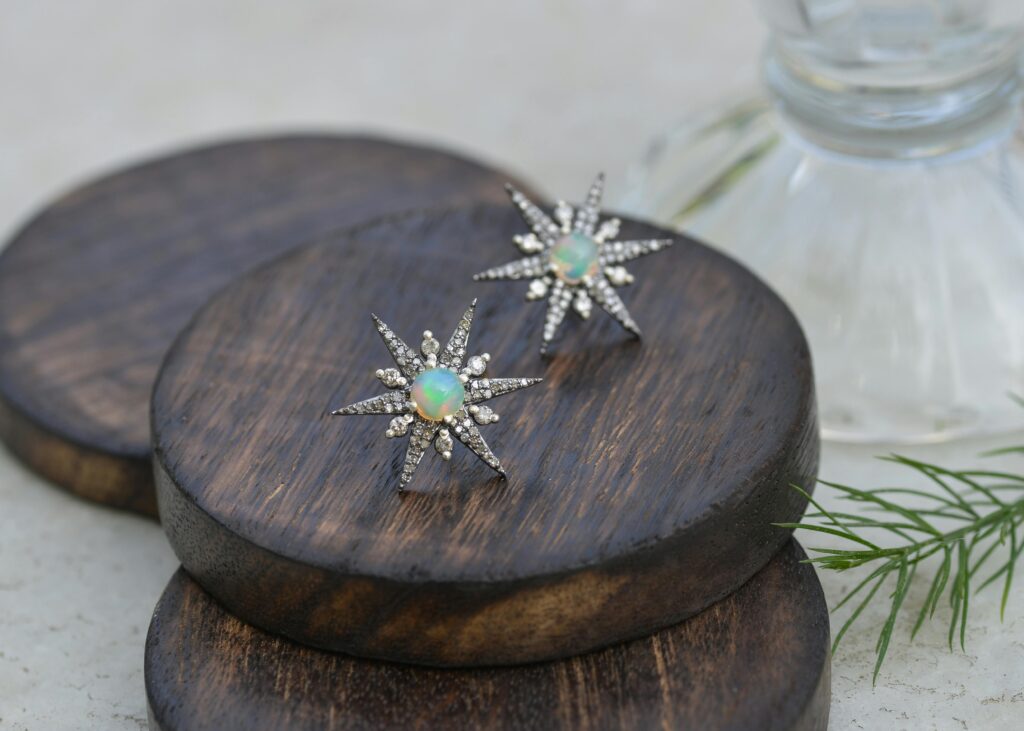
- Opal Earrings: Opal earrings are beloved because they allow the stones to catch light from many angles, really showing off that play-of-color with movement. A pair of opal studs (small round or oval opals) can add a touch of color to everyday wear, especially if you prefer an understated look compared to flashy gems.
Dangling opal earrings or opal drop earrings can be more dressy – imagine opal teardrops swinging from the ear, flashing green and blue fire as you turn your head. Many opal earrings feature white opals in silver or white gold for a classic appeal, but black opal or boulder opal earrings in gold can make a luxurious statement.
One tip: since opals in earrings are a bit safer (they aren’t likely to be knocked or rubbed as much as rings), you can indulge in more delicate or exposed designs without as much worry about damage. Earrings are also a great way to wear raw opals or unusual shapes, since even if the opals are irregular, they can hang freely and be appreciated. - Bracelets & Other Jewelry: Opal bracelets or opal bangles are less common than rings or earrings, but they exist. Typically, you’ll find tennis bracelet styles with small opal cabochons, or cuff bracelets with an opal centerpiece.
Because wrists can hit surfaces often, one has to be careful with opal in a bracelet – a secure setting is a must (bezel settings are common to protect the stone). Opal brooches were quite popular in vintage jewelry, often with elaborate flower or insect designs where opals formed the bodies of the motifs. These can be gorgeous collector’s pieces and a nice way to wear opal on a lapel or scarf.
Opal cufflinks and tie tacks for men are a classy way to add personality to a suit – typically using sturdy black or boulder opal. Indeed, opal jewelry for men tends to focus on accessories like cufflinks or signet rings with opal inlay, as the stone’s flash and often darker tones in black opal can give a masculine, distinguished look. - Body Jewelry (Nose, Navel, etc.): Opal has even found a niche in body piercings. Opal nose studs or rings are a popular choice for nostril piercings – a tiny opal (often synthetic for cost and durability) gives a brilliant little flash of color on the nose.
Opal’s range of colors means you can get a subtle white opal nose stud that mostly looks pearly with a hint of pastel, or a flashy multi-color opal that stands out. Similarly, opal navel jewelry (belly rings) are sought after for their playful sparkle; a common style is a curved barbell with an opal cabochon on each end.
The reason opals are favored in these pieces is the same reason they enchant in other jewelry: they pack a lot of visual impact in a small size. A small gem can still show multiple colors and catch eyes. Just ensure body jewelry opals are in secure, protective settings (many use bezel cups) so the opal won’t chip.
And since body jewelry may be exposed to water (swimming, showering), using lab-created opals or resin-based opals might be wiser, as they handle moisture and rough use better than a fine natural opal would.
In any form of jewelry, opal is a conversation starter. Don’t be surprised if strangers lean in to admire your opal pendant or if friends ask about your shimmering earrings. Each piece of opal jewelry carries a tiny world of color within it, and wearing one is like wearing a work of art crafted by nature.
Metal Choices and Complementary Stones for Opal Jewelry
One of the fun aspects of designing or selecting opal jewelry is choosing the metal and any accent stones to pair with your opal. Because opals display all colors, they can truly go with any metal tone – it just depends on the effect you want:
- Yellow Gold: Classic and rich, yellow gold has been a long-standing companion to opals. The warm hue of gold often enhances the warmth in opals (bringing out reds and oranges). Many vintage opal rings were made in yellow gold.
It’s an excellent choice if you want a timeless or antique look. For example, an opal ring in vintage gold (yellow gold) with a simple design can look straight out of a Victorian fairy tale. Yellow gold also contrasts nicely with the cooler flashes like blues and greens, creating a balanced presentation. - Rose Gold: As mentioned earlier, rose gold opal jewelry is very on-trend. The pinkish tone of rose gold adds romance and pairs especially well with opals that have a lot of red, pink, or orange play-of-color. Rose gold settings often give opal pieces a vintage-meets-modern feel – vintage because rose gold has that old-world charm, but modern because it’s been rediscovered by contemporary designers. Opal engagement rings in rose gold are frequently seen in bohemian or alternative bridal styles.
- White Gold & Platinum: White metals (including sterling silver) offer a cool, neutral backdrop that lets all the colors of the opal take center stage. Many people choose opal rings in silver or white gold especially when the opal has strong blue/green tones, as the cool metal complements those hues.
White metals also match with diamonds and other colorless accent stones seamlessly. If you’re adding diamonds around your opal (say a halo or side stones), setting the piece in white gold or platinum can unify the look and really make the opal “pop” with contrast.
For instance, a black opal set in platinum with a halo of white diamonds is a striking high-end design – the silvery metal doesn’t distract from the opal, and the diamonds highlight the opal’s fire. Opal engagement rings silver (sterling) are more affordable and quite popular on the artisan market – just be mindful that silver is softer and may need polishing over time as it tarnishes. - Mixed Metals: Opal jewelry also lends itself to mixed metal designs. You might see a pendant where the base is white gold but there are yellow gold prongs or accents, tying in different colors from the stone. Some designer pieces use blackened silver or oxidized metals around opals to create an antique or gothic look (especially with opals that have bright flashes – the dark metal makes the colors dramatic). There’s plenty of room to be creative.
Complementary gems often used with opals include diamonds, cubic zirconia (CZ) or white topaz (for a budget-friendly sparkle), pearls (for a soft, romantic combination – opals and pearls together evoke a very vintage vibe), and even colored stones that pick up a tone from the opal.
For instance, small sapphires or emeralds could be used as side stones to accent certain colors in a multicolor opal. One striking combination is opal with tanzanite or amethyst, which can emphasize purple flashes.
When adding diamonds or other gems, jewelers often use them not just for looks but as a protective measure: a halo or a cluster around an opal can shield it from direct impact. So it’s both beautiful and practical.
Shopping Tips: Finding Quality Opal Jewelry Online and In-Store
If you’re now excited to purchase an opal piece, let’s talk about how to shop smartly for opal jewelry. With the rise of e-commerce, you can easily find opal jewelry online – from big retailers to specialized opal dealers. Here are some tips to ensure you get the best value and a genuine product:
- Know Your Opal Type: As we covered in the types section, opals can be natural solid, doublet, triplet, or synthetic. When browsing opal jewelry online, read descriptions carefully. Reputable sellers will clearly state if an opal is lab-created or a doublet/triplet composite. For example, a listing might say “opal doublet ring in sterling silver” – this tells you it’s a slice of opal with backing.
There’s nothing wrong with buying those (they are often beautiful and affordable), but you should know what you’re paying for. A “created opal pendant” likely means the opal is synthetic. If a deal seems too good to be true (e.g., a large, intensely colorful opal ring for a very low price), it could be a fake or a triplet being passed off as solid. Always buy from trusted jewelers or platforms with good reviews. - Real vs Fake: The search term opal ring real hints that buyers worry about authenticity. Natural opals have certain irregularities and a depth to their fire that high-quality synthetics try to mimic but can be distinguished with experience.
Some quick clues: natural precious opals often have a random, non-uniform pattern of color flashes, whereas some synthetic opals show a “lizard skin” or pixelated pattern under magnification. Also, the base of a doublet or triplet might look black from the back or have a visible glue line from the side. When in doubt, ask the seller or have the piece evaluated by a jeweler.
Buying from known retailers like Kay, Zales, JCPenney, Jared, etc., you will usually get honest marketing – e.g., Kay might label something as “lab-created opal” if it is. In fact, many mainstream jewelry stores sell lab opal jewelry because it offers consistency and bright colors at low cost. If you specifically want a natural opal engagement ring set (with genuine opals), be sure to verify that. - Brands and Designers: Many big-name jewelers and designers incorporate opals. Kendra Scott was mentioned earlier for fashion-forward pieces (often using imitation opal in trendy styles). Kay Jewelers and Zales frequently include opals in their October birthstone collections – you might find an opal ring at Zales in 10k or 14k gold with diamond accents, or an opal necklace at Jared with a halo design.
These store collections are convenient and often come with warranties, but do compare prices and quality (the opals in mass-market pieces might be moderately priced whites or triplets; high-end black opals you’d typically find through specialized dealers or custom designers). There are also boutique designers known for opals: Australian opal specialists like Black Opal Direct, or jewelers who make opal inlay jewelry (Mark Hileman’s opal inlay rings, for instance, are sought by men for wedding bands).
If seeking something like opal jewelry men might wear, look for designers offering tailored masculine styles – often using black opal, boulder opal, or geometric inlays. - Online Marketplaces: You can find opal rings on sale on marketplaces like Etsy, eBay, or specialized sites. When something is on sale or a really good price, double-check the details (ask for photos in different lighting, inquire if any cracks or crazing in the opal, confirm metal purity).
On Etsy, many skilled artisans create custom opal rings – this is a great way to get a one-of-a-kind piece, perhaps even choose your loose opal and a setting design. Just ensure the artisan has good reviews and stands by their work. Opal jewelry on sale during clearance events or Black Friday can be an opportunity to snag a deal from reputable retailers – but again, buy from sources that clearly describe the gem’s nature. - Consider Australian Sellers: Since Australia is opal central, buying from Australian dealers can sometimes get you better value or more variety of opals straight from the source (especially for boulder and black opals). Just factor in shipping and import fees if applicable.
There are well-known opal auction sites and dealers online (like Opal Auctions, Lightning Ridge dealers) – these can be wonderful if you know how to evaluate opals, but beginners should perhaps start with a finished piece from a jeweler to be safe. - Budgeting: Opal pricing varies wildly. Common white opals or small calibrated stones can be quite affordable (you might see opal rings on sale for under \$100 if they’re in silver with a modest stone). On the flip side, a fine 2-carat black opal with red fire can cost more than a diamond of equal size!
Have a budget in mind and see what types of opal fall into it. If your budget is lower, you’ll likely be looking at white opal, fire opal, or doublets/synthetics – which can still give you that opal magic without breaking the bank. If you have a higher budget, consider investing in solid opal from a good source, as it may retain value and certainly will be a rarer treasure to own.
Caring for Your Opal Jewelry
Once you have opal jewelry in your collection, you’ll want to keep it looking as lovely as the day you got it. As we’ve emphasized, opal is more delicate than many gems, but with proper care, it can last for generations. Here are essential care tips for opal pieces:
1. Protect from Scratches and Impact: Opals can scratch relatively easily and may chip or crack if knocked. Always store opal jewelry separately – ideally in a soft pouch or a velvet-lined jewelry box where it isn’t jostling against harder items.
Never toss your opal ring loose in a box with diamond rings, for example. When doing activities like sports, heavy cleaning, gardening, or lifting weights, take off your opal rings/bracelets to avoid accidental hits. It’s better not to wear opal rings while washing dishes or hands in very hot water either (to avoid rapid temperature change and soapy residue).
2. Avoid Heat and Extreme Dryness: Opals should not be subjected to high heat or sudden temperature swings. Don’t leave an opal piece in a hot car or near a windowsill in direct sun for long periods. If you live in a very dry climate or keep jewelry in a dehumidified safe, consider storing opals with a small vial of water or a damp cotton pad in a perforated bag nearby (not touching the opal, but to maintain some humidity in the air).
This is to prevent the opal from losing moisture over time. While solid opals are usually stable, precaution helps, especially for Ethiopian hydrophane opals. Conversely, do not soak opals in water habitually – a brief rinse is fine, but extended submersion (like leaving in water overnight) could seep into any microscopic pores or the glue of doublets/triplets and cause cloudiness. Essentially, opals like a moderate environment – not too hot, not too cold, not too dry, not too wet.
3. Gentle Cleaning Only: The safest way to clean opal jewelry is with warm water, mild dish soap, and a soft cloth or soft toothbrush. Gently wipe the piece, then rinse and pat dry with a clean microfiber or cotton cloth. Do NOT use ultrasonic cleaners or steam cleaners on opals. The vibrations from ultrasonics can cause cracks, and steamers (as well as boiling methods) can literally dry out or overheat the gem, risking damage.
Also avoid harsh chemicals, bleach, or cleaners meant for metals while the opal is in the piece – if you need to polish the metal, it’s best done by hand carefully, or by a jeweler who can protect the stone. Opals also don’t like acid, so keep them away from substances like lemon juice or vinegar (not usually an issue unless you’re doing something like cleaning with vinegar or cooking and accidentally get some on your ring – just rinse it off promptly).
4. Regular Check-ups: Especially for rings, check the setting occasionally to ensure the opal is secure. Because opals are often cut en cabochon (with a smooth domed top), they might be held by prongs or a bezel. Prongs on a soft stone can loosen if snagged. If you notice any movement of the opal in its setting or any new cracks, take the piece to a professional jeweler for inspection.
It’s wise to have fine opal jewelry inspected and cleaned professionally about once or twice a year. Jewelers can also re-polish an opal that gets surface scratched over time, restoring its gloss (this should be done by experts only, as opal cutting is delicate).
5. Wearing Tips: Apply any hairspray, perfume, or cosmetics before putting on opal earrings or necklaces – opals have a relatively porous surface that could absorb chemicals and get dull. When removing an opal ring, do so over a soft surface or close to a table – just in case it slips, you don’t want it falling onto a hard floor.
If you plan to not wear an opal ring for a long stretch, storing it in a slightly humid place as mentioned is good; some also wrap it in a soft damp cloth sealed in a bag, but then you must refresh the moisture occasionally. Honestly, for most modern opals, normal home humidity is okay.
By following these care guidelines, your opal’s colors will remain vibrant and the gem will stay intact. Opals might have a little reputation as “high maintenance” compared to diamonds or sapphires, but many devoted opal lovers will tell you the care is well worth it. After all, you’re taking care of a gemstone that’s essentially a tiny geological miracle – once just silica-rich water in the ground, now a solid gem displaying all the colors of the rainbow.
Conclusion: Embracing the Magic of Opal
In the world of gemstones, opal stands in a league of its own. Few other stones can boast the mesmerizing array of colors that opal flashes with each turn of the hand. Owning an opal jewelry piece – be it a captivating opal engagement ring, a pair of luminous earrings, or a pendant glowing with inner fire – is like holding a piece of a rainbow. It’s a gem that invites admiration and starts conversations, yet also carries a rich tapestry of myth and meaning that you, as the wearer, become a part of.
For those considering an engagement ring, opal offers an avenue to express individuality and romance, especially if you’re enchanted by its look and lore. For jewelry enthusiasts, adding an opal to your collection brings diversity and that “wow” factor. Just remember, as opal dazzles you with its beauty, to treat it with the gentle care it deserves so it can continue dazzling for years to come.
Whether you’re drawn by the vintage charm of a milky white opal in yellow gold, the modern flair of a black opal ring with a diamond halo, or the boho-chic appeal of a raw opal set in handcrafted silver, there is an opal jewel out there waiting to be your personal treasure. Explore the options, heed the care advice, and let your intuition (and perhaps a little research) guide you to the perfect piece. With its ever-changing colors and light, opal truly is a gem to celebrate — a sparkling reminder that nature’s artistry is often full of surprises and wonder.
So go ahead and indulge in the magic of opal jewelry. With one of these radiant gems by your side (or on your finger!), you carry a bit of rainbow light with you wherever you go – and that is a beautiful thing indeed. Opal jewelry can be the crown jewel of your collection, a conversation piece, and a cherished heirloom, all wrapped in one brilliant, colorful package. Embrace its beauty, and enjoy the compliments and joy it brings!
Sources: