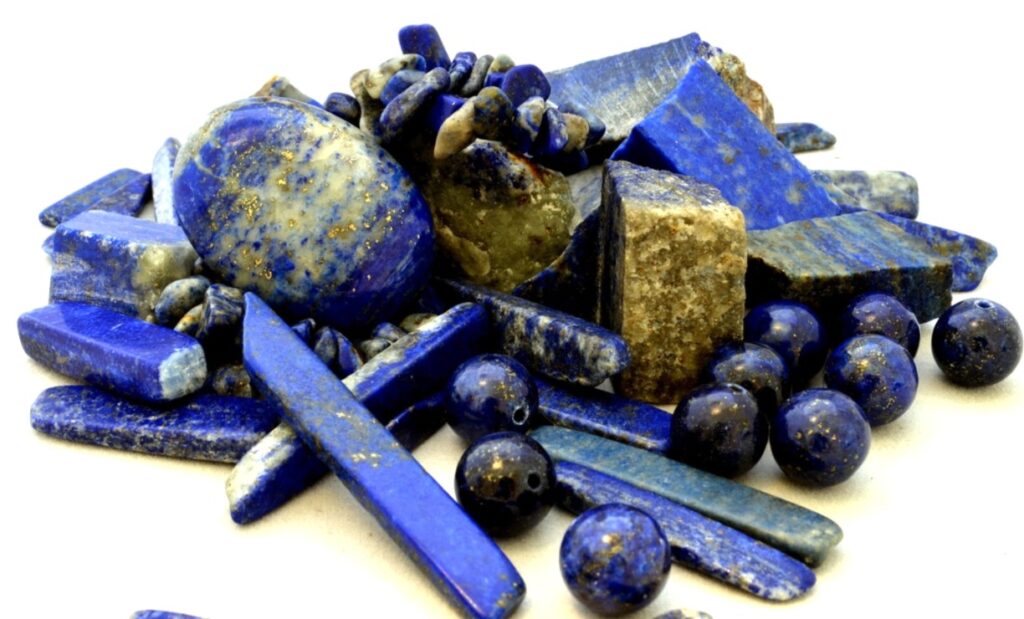
Lapis lazuli is an opaque blue gemstone that has captivated humanity for millennia. Its name literally means “blue stone,” and it displays a celestial lapis lazuli blue color often sprinkled with golden sparkles of pyrite. This striking appearance made lapis lazuli a symbol of royalty, wisdom, and truth in many ancient cultures.
From the jewelry of Egyptian pharaohs to the ultramarine pigment in Renaissance paintings, this gemstone’s rich history is as vibrant as its hue. In modern times, lapis lazuli remains popular in jewelry and is celebrated both for its beauty and its spiritual meaning.
In this article, we explore what lapis lazuli is, its properties, history, symbolic significance, uses in jewelry, and even its appearances in pop culture, in a way that is professional yet easy to understand.
Contents
- 1 What is Lapis Lazuli? (Definition and Properties)
- 2 A Journey Through History and Lore
- 3 Meaning, Symbolism, and Spiritual Properties
- 4 Lapis Lazuli in Jewelry and Fashion
- 5 Quality, Value, and Care of Lapis Lazuli
- 6 Lapis Lazuli in Pop Culture and Modern Media
- 7 The Enduring Allure of Lapis Lazuli
- 8 Frequently Asked Questions about Lapis Lazuli
- 8.1 What does lapis lazuli do?
- 8.2 Is lapis lazuli real?
- 8.3 Is lapis lazuli expensive?
- 8.4 What does lapis lazuli mean?
- 8.5 What is lapis lazuli used for?
- 8.6 How much is lapis lazuli worth?
- 8.7 Where does lapis lazuli come from?
- 8.8 What does lapis lazuli look like?
- 8.9 What does lapis lazuli symbolize?
- 8.10 Where is lapis lazuli found?
What is Lapis Lazuli? (Definition and Properties)
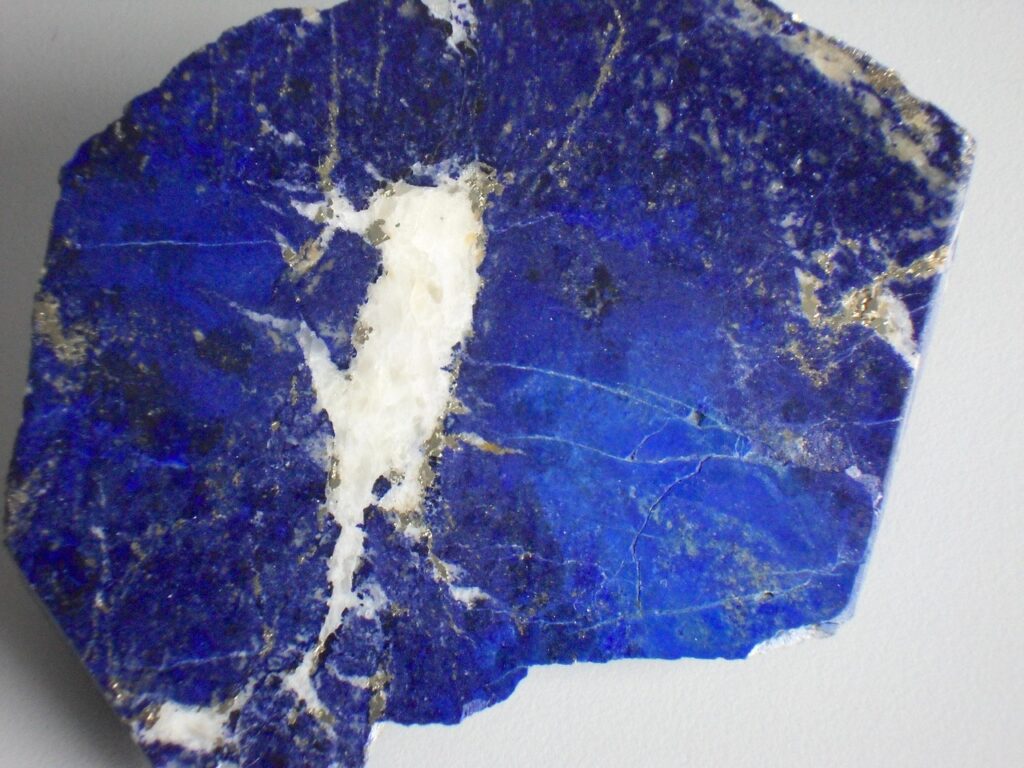
Lapis lazuli is not a single mineral but a metamorphic rock composed primarily of several minerals. The most important component is lazurite, a deep-blue mineral that gives lapis its intense color.
In addition, lapis lazuli typically contains calcite (which appears as white streaks or patches) and pyrite (which shows up as tiny golden flecks that sparkle like stars).
These inclusions make each piece of lapis unique – the golden pyrite can look like galaxies in a blue sky, while calcite marbling can create a “denim” lighter blue variety known in the trade as denim lapis.
In terms of physical characteristics, lapis lazuli is relatively soft for a gemstone. It ranks about 5 to 5.5 on the Mohs hardness scale, similar to the hardness of window glass. This means it can be scratched more easily than harder gemstones like sapphires or diamonds. Its toughness is fair, and it is somewhat porous.
Lapis has a waxy luster when polished, rather than a high sparkle, because it is an opaque stone. It is usually cut as cabochons (smooth domed shapes), beads, or carved into ornamental objects, rather than faceted, since it does not transmit light.
The stone’s color is its most prized feature – the best lapis lazuli is an intense royal or ultramarine blue, often uniform in tone with just a sprinkling of golden pyrite and minimal white calcite. Lower-grade lapis may appear paler blue with considerable white, which is less valued and termed denim lapis for its resemblance to blue jeans.
Pronunciation of Lapus Lazuli
How do you say “lapis lazuli”? In English it is commonly pronounced as LA-pis LAZ-oo-lee, with the emphasis on the first and third syllables. (The name comes from Latin lapis for “stone” and lazuli, which derives from the Persian lāzhward, meaning “sky” or “heaven,” a reference to its heavenly blue color.) The word lazuli also gave us the term “azure” for blue in many languages.
Because of its composition, lapis lazuli can be sensitive to acids and strong chemicals – the calcite in it might fizz or dull if it contacts something like vinegar. Despite being somewhat delicate, lapis has been treasured for thousands of years due to its unparalleled color.
Lapis Lazuli a prized blue gem
In a world with few blue gemstones, lapis lazuli stands out as a prized blue gem (there are not many natural deep-blue gems aside from sapphires). It has even been traditionally considered an alternative December birthstone, alongside turquoise and zircon.
Below is a quick overview of lapis lazuli’s key properties:
| Property | Description |
| Color | Intense deep blue, often with golden pyrite flecks and whitish calcite veins. |
| Composition | Rock composed of lazurite (blue), calcite (white), pyrite (golden), and other minerals. |
| Hardness | ~5–5.5 on Mohs scale (moderate; can be scratched by harder gems). |
| Luster | Waxy, dull glow when polished (opaque, not sparkling like transparent gems). |
| Transparency | Opaque (does not transmit light). |
| Crystal System | Aggregate of several minerals; lazurite is cubic, but the stone itself is not a single crystal. |
| Specific Gravity | ~2.7–2.9 (average density for a semi-precious stone). |
| Name Origin | From Latin lapis “stone” + Medieval Latin lazulum from Persian lāzhward “blue, heaven”. |
These properties explain why lapis lazuli is relatively easy to carve and shape – its softness means it can be cut into intricate designs or engraved for intaglio and cameos. However, they also mean that jewelry made with lapis needs a bit of care to avoid scratches or damage (more on care later).
Now that we know what lapis lazuli is, let’s delve into its rich history and the legends surrounding this gorgeous blue stone.
A Journey Through History and Lore
Lapis lazuli’s story begins in some of the world’s oldest mines. Archaeological evidence shows that as early as the 7th millennium BC, lapis lazuli was being mined in the Badakhshan region of northeastern Afghanistan.
These ancient mines at Sar-i Sang in Badakhshan produced high-quality lapis that found its way along trade routes to the great civilizations of antiquity. In fact, Afghanistan’s lapis lazuli was the source of the stone for the ancient Egyptians, Mesopotamians, Greeks, and beyond. The gem’s intense blue was linked with the heavens, and ancient cultures believed it had divine connections.
Ancient Egypt
Perhaps no civilization is more associated with lapis lazuli than ancient Egypt. The Egyptians called the stone chesbet and esteemed it as a stone of the gods and royalty. Pharaohs adorned themselves with lapis lazuli jewelry, and it was used to create amulets and insignia of power.
Lapis Lazuli Mask
Notably, the funeral mask of Pharaoh Tutankhamun (King Tut) is inlaid with brilliant blue lapis lazuli alongside gold and other gemstones. This striking contrast of blue and gold symbolized the sun and sky, fitting for a king’s regalia. Egyptian judges in later periods wore pendants of Maat (the goddess of truth) carved from lapis lazuli over their hearts, signifying wisdom and justice.
According to legend, Cleopatra even used powdered lapis lazuli as an eye shadow cosmetic to create that famous deep-blue eyeliner – essentially using the stone as a luxurious makeup pigment!
Mesopotamia and the Near East:
In ancient Sumer (modern-day Iraq), lapis lazuli was known as a stone of the gods and was highly prized.
One of the oldest recorded myths, the tale of the goddess Inanna (later known as Ishtar), dating to around 4000 BCE, describes her descending into the underworld adorned with a lapis lazuli necklace and rod, symbols of her power.
The Royal Tombs of Ur (also in Mesopotamia) yielded many lapis lazuli beads and ornaments when excavated, indicating that even in the 3rd millennium BC, this stone was reserved for elite burials. Lapis was also carved into cylinder seals – little rolling stamps used to sign documents or clay tablets – because it was tough enough to hold an intricate engraving yet soft enough to carve relatively easily. These lapis cylinder seals would imprint detailed images and cuneiform script when rolled over wet clay, and often the seals themselves were worn as amulets or jewelry.
The Biblical Connection:
Lapis lazuli may appear in ancient texts under different names. Many scholars believe that references to “sapphire” in the Bible actually meant lapis lazuli, since true sapphire (corundum) was likely unknown or exceedingly rare in the Middle East at that time. For example, the Hebrew word sappiyr in the Old Testament (Exodus 28:18) describes one of the stones in the High Priest’s breastplate.
Although often translated as sapphire, some experts argue this stone was lapis lazuli – especially because the text says the names of the tribes of Israel were engraved on it, and engraving a hard sapphire (Mohs 9) would have been impractical, whereas lapis lazuli can be engraved with relative ease due to its softness. Moreover, in the Book of Exodus, when Moses and the elders of Israel envision God on Mount Sinai, it says, “Under His feet was something like a pavement made of lapis lazuli, as bright blue as the sky” (Exodus 24:10, NIV).
This vivid image of a heavenly blue stone under God’s throne again suggests how sacred and precious lapis’s color was in ancient eyes – a piece of the sky itself. Lapis lazuli is also mentioned in other biblical passages, symbolizing beauty and wealth (e.g., Ezekiel’s lament for Tyre mentions “sapphire and lapis lazuli” among its treasures). These references highlight that lapis was one of the most cherished gemstones of the ancient world, associated with the divine and the majestic.
Other Ancient Cultures
The use of lapis lazuli was not confined to the Near East. The Indus Valley Civilization (in present-day Pakistan/India) also obtained lapis through trade and used it in jewelry and small carvings. In later classical times, the Greeks and Romans valued lapis lazuli for carving cameos and intaglios, and for its believed medicinal properties.
According to folklore, the Greeks and Romans ground lapis into powder to use as a medicinal tonic, believing it could cure ailments like insomnia or melancholy. (We now know ingesting lapis is not safe due to its mineral content – a practice best left in the past!) Ancient Chinese civilization also carved lapis lazuli into ornamental figurines, beads, and inlays. By the middle ages, lapis was reaching Europe via Venetian trade with the Middle East, and it continued to be treasured.
The Gift of Ultramarine
Beyond jewelry, lapis lazuli’s legacy includes art. In the Renaissance period, artists craved a brilliant blue pigment that wouldn’t fade – and they got it by grinding high-quality lapis lazuli into a fine powder. The result was ultramarine, the most coveted blue paint in history. Ultramarine (meaning “beyond the sea,” referencing that lapis came from across the sea in Afghan mines) was so expensive that it was literally worth more than its weight in gold during the 14th-16th centuries.
Renowned artists like Michelangelo and Vermeer reserved ultramarine for their most important subjects. For instance, they often painted the Virgin Mary’s blue robes with lapis lazuli pigment to signify her importance. The Sistine Chapel’s frescoes include heavenly blues derived from lapis lazuli, showcasing the stone’s contribution to world art.
This demand for lapis in painting continued until 1826, when a synthetic pigment (French ultramarine) was developed, providing a cheaper alternative to ground lapis lazuli. Nevertheless, natural ultramarine has never fully lost its allure; even today, some restoration artists and icon painters seek out genuine lapis lazuli pigment for its unique vibrancy.
Through all these uses, lapis lazuli gained a reputation as a stone of royalty, truth, and the divine. Many cultures believed that the soul or spirit could inhabit this stone or that it was a key to spiritual enlightenment. This brings us to the meanings and spiritual properties attributed to lapis lazuli over time.
Meaning, Symbolism, and Spiritual Properties
Lapis lazuli has long been associated with wisdom, inner truth, and self-expression. Its deep blue color, reminiscent of the midnight sky, naturally led ancient people to connect it with the heavens, gods, and the concept of enlightenment. In ancient lore, as mentioned, it was the “Stone of Kings” and also thought to contain the soul of a deity, rejoicing in whoever possessed it. This stone became a universal symbol of royalty and honor, gods and power, spirit and vision.
Truth and Wisdom
One of the key symbolic meanings of lapis lazuli is truth. In Egypt, the formula for truth included the scales of Ma’at (truth) balanced by a feather, and judges wearing lapis amulets believed they were guided to uphold truth.
The stone’s use in signet seals and emblems of authority also reinforced its connection to truthful dealings and wisdom. In modern crystal lore, lapis is said to enhance intellectual ability and memory, and to help one speak truth with confidence. It is a favored stone for students and truth-seekers as it supposedly clears the mind’s vision and aids problem-solving by unifying the mind and voice. Because of this, some call it the “Stone of Wisdom.”
Spiritual and Healing Properties
In the realm of crystal healing and New Age belief, lapis lazuli is credited with numerous benefits. It is thought to alleviate stress and bring deep peace to the wearer. Healers say it can benefit the respiratory and nervous systems and reduce inflammation, and even help identify the karmic roots of disease (for those who believe in spiritual causes of illness).
In ancient times, people used lapis lazuli in powders and potions for fevers and blood disorders. Today, gem experts strongly caution against ingesting it because it contains sulfur compounds. They emphasize that stones serve for wearing or adornment, not eating. Supporters now claim any “healing” benefits come from wearing the stone against the body or using it in meditation.
Chakras and Intuition
Lapis lazuli is often associated with the Third Eye chakra (Ajna) in Eastern spiritual traditions. This is the energy center on the forehead linked to intuition, insight, and psychic abilities. Meditators will place lapis lazuli on the third eye area to encourage visionary insights and enhance intuition.
The stone is said to help open the third eye, granting clarity and connection to the spiritual realm. It is also connected to the Throat chakra, aiding in clear communication and self-expression – hence helping one speak the truth clearly and with authority, just as ancient wearers believed it gave them authority and speech prowess.
Emotional Benefits
Energetically, lapis is believed to uplift the mood and chase away the “blues” (ironically, with its blue color). It promotes self-awareness and the acceptance of knowledge. In crystal folklore, wearing or carrying lapis lazuli can encourage honesty, compassion, and uprightness. It is also considered a stone of friendship and harmony – people used to exchange lapis lazuli pieces to symbolize loyalty. Its vibrations are said to attract positive energies and spirit guardians.
Modern practitioners of crystal healing and feng shui might place lapis lazuli in their home or office to enhance wisdom energy, or wear it as a talisman during times when clarity and good judgment are needed. Some even place small lapis lazuli stones on their desks, believing it will help them concentrate and ward off negative influences. It’s clear that beyond its aesthetic appeal, lapis lazuli carries a heavy load of symbolic meaning. As one source eloquently put it, the stone’s deep, celestial blue remains a symbol of royalty, honor, spirit, and vision – a universal symbol of wisdom and truth.
To summarize some popular beliefs about lapis lazuli’s powers and meanings:
- Inner Wisdom & Intuition: Encourages spiritual insight, intuition, and connection to truth. Often used to stimulate the Third Eye for clearer vision and judgment.
- Communication: Helps one speak the truth and communicate effectively. Believed to activate the Throat chakra, ensuring your voice reflects your inner thoughts honestly.
- Stress Relief & Peace: Its calming deep-blue presence is thought to relieve stress, bring inner peace, and combat depression or sadness (a cure for the “blues”).
- Protection: In ancient times, lapis lazuli amulets were considered protective, guarding the wearer from the evil eye and negative energies.
- Physical Healing (Folklore): Said to benefit throat, lungs, and immune system; reduce inflammation; and alleviate insomnia. (These are traditional claims without scientific backing, so take them as spiritual folklore.)
- Friendship & Harmony: Symbolizes friendship, brings harmony in relationships. Lapis lazuli is sometimes exchanged as a token of friendship and goodwill.
Whether one subscribes to these metaphysical properties or not, there is no denying that lapis lazuli has a profound cultural and spiritual legacy. Its very presence in crown jewels, religious rituals, and healing practices through history underscores the deep human connection we feel with this stone.
Lapis Lazuli in Jewelry and Fashion
After thousands of years, lapis lazuli jewelry is still as popular as ever. The gemstone’s bold color makes it a favorite for statement pieces, and its opaque nature lends itself well to large, smooth cuts and creative designs.
Jewelers and artisans from ancient goldsmiths to modern designers like Tiffany & Co.’s Elsa Peretti and Paloma Picasso have incorporated lapis lazuli into their creations, showcasing its versatility and timeless appeal. Let’s explore how lapis lazuli is used in jewelry, what types of pieces are common, and how it suits both men’s and women’s jewelry styles.
Why Lapis for Jewelry?
Lapis lazuli’s deep blue provides a wonderful contrast with metals. Set in yellow gold, the stone’s blue is accentuated by the metal’s warmth and the pyrite flecks seem to echo the gold color – a combination that screams luxury (no wonder ancient kings loved pairing lapis with gold).
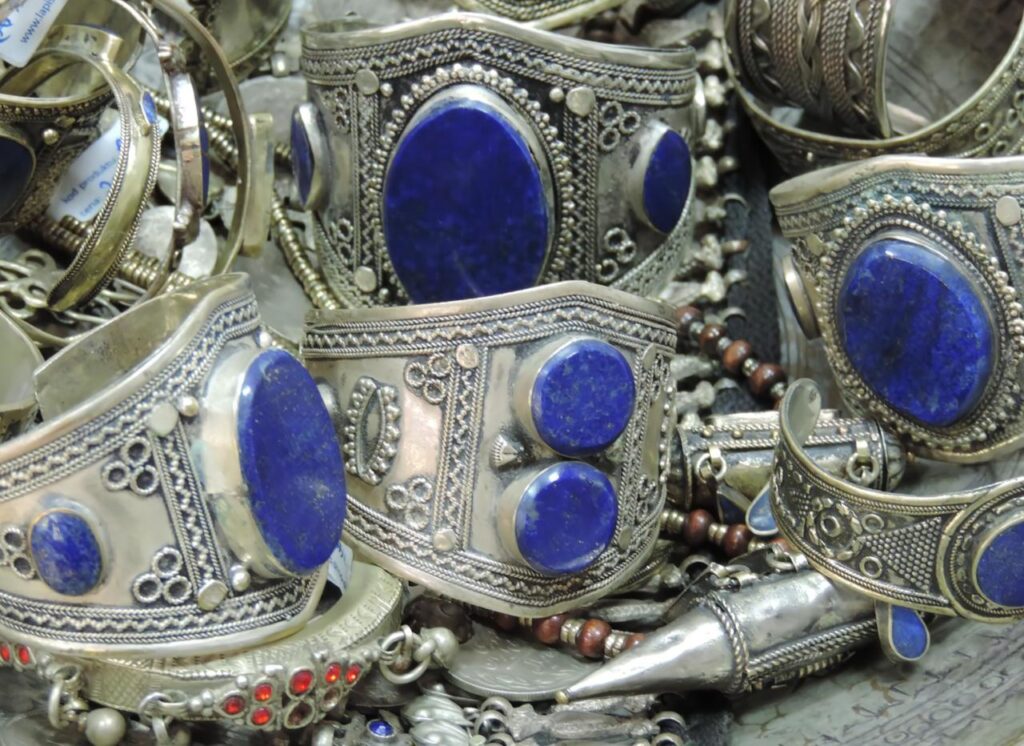
In sterling silver or white gold, lapis takes on a modern, chic look: the cool tones of the metal highlight the richness of the blue. The stone is relatively easy to cut and polish, so it can be worked into many shapes – from classic ovals and rounds to imaginative carvings like scarabs, floral motifs, or even heart shapes. However, because it’s not extremely hard, jewelers avoid very exposed designs for rings that will see heavy wear. Lapis is often cut as cabochons (domed shapes) for rings and earrings, or into smooth beads for necklaces and bracelets. You’ll also find flat slices of lapis used as inlay or even watch dials.
Here are some common and popular lapis lazuli jewelry types:
- Necklaces & Pendants
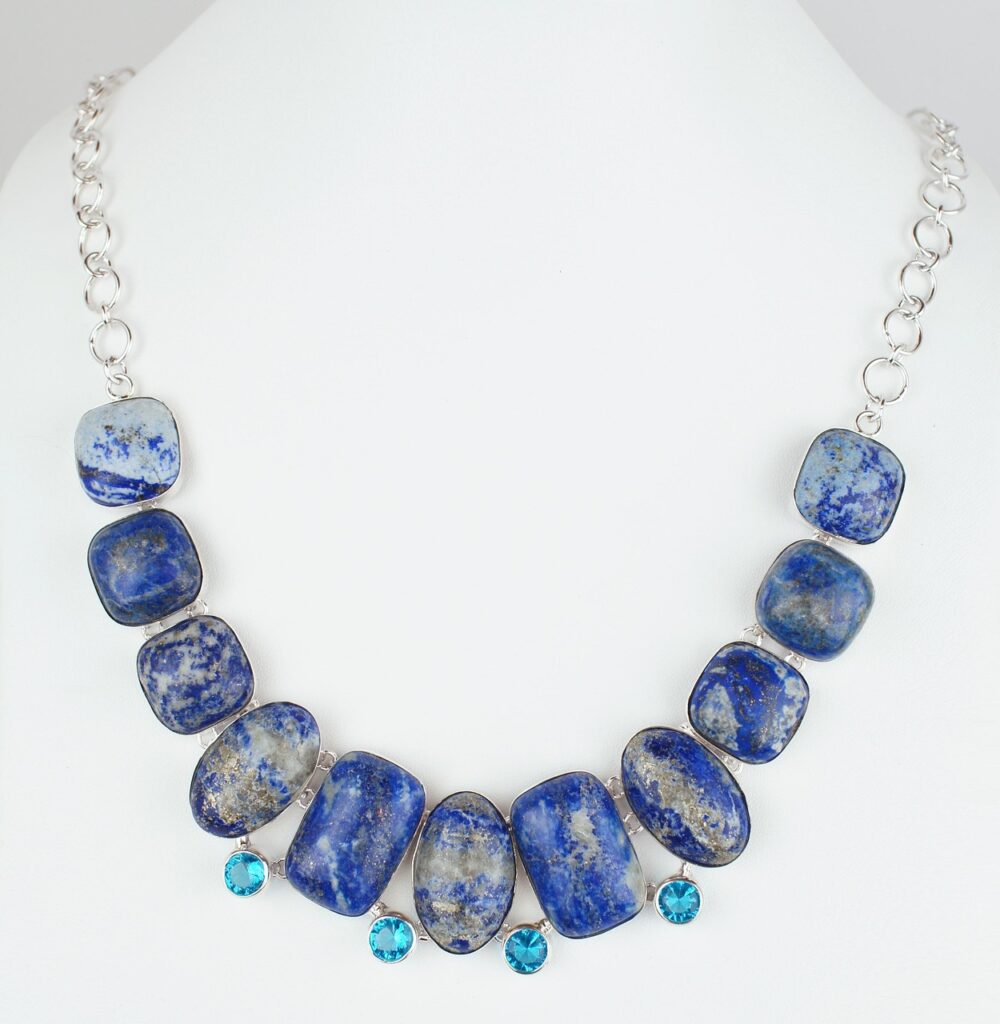
Lapis lazuli shines in necklaces, whether as strands of round lapis lazuli beads or as a single bold lapis lazuli pendant hanging from a chain. A string of polished lapis beads – often alternating with gold spacers or small pearls – makes a striking lapis lazuli necklace. Many designers also create pendants featuring one large lapis cabochon in a gold frame, sometimes accented with diamonds. Lapis lazuli mala necklaces (prayer bead strands) are also popular, especially in yoga and meditation communities, combining spiritual practice with elegant beauty.
- Earrings
Because of its color, lapis lazuli works beautifully in earrings. Simple lapis lazuli stud earrings (small round or oval cabochons on posts) add a touch of color to everyday wear. For more drama, drop or dangle earrings might feature lapis lazuli stones in teardrop or geometric shapes. Lapis lazuli earrings in silver have a cool-toned elegance, while lapis lazuli earrings in gold give a richer, classic look. Many vintage-inspired designs use lapis orbs or carved lapis drops suspended from filigree settings.
- Rings
A lapis lazuli ring is an excellent statement piece. Women’s lapis rings often feature a large oval or cushion-shaped lapis stone as a centerpiece, maybe surrounded by a halo of small diamonds or set in a textured gold band. Men’s lapis rings are also quite popular – a lapis lazuli ring for men is often designed as a signet or dome ring, with the blue stone giving a bold pop of color that still feels masculine.
In fact, some men’s signet rings have lapis lazuli engraved with family crests or monograms. Both silver and gold lapis rings exist; a lapis lazuli ring (mens) might pair the stone with sterling silver for a contrasting look, or with heavy gold for a luxurious style. It’s worth noting that due to lapis’s moderate hardness, rings should be worn with some care (probably not as an everyday ring if you work with your hands a lot, to avoid scratching).
- Bracelets
Lapis lazuli is commonly seen in bracelets, particularly as beads. A lapis lazuli bracelet can be a single strand of round beads, which showcases the stone’s color nicely on the wrist. These bead bracelets are unisex – you’ll see lapis lazuli bracelets for men that might use larger 8-10mm beads, often knotted or spaced with dark onyx or metal accents for a chunky, bold look.
Women’s lapis bead bracelets might be smaller beads or combined with other gemstones for a colorful mix. There are also more formal bangle or link bracelets using lapis cabochons set in metal. For example, a designer might create a gold link lapis lazuli bracelet (mens or womens) featuring several oval lapis stones in each segment. Lapis inlay bracelets – where pieces of lapis are set flush into a gold or silver cuff – are another stylish design.

- Watches and Accessories
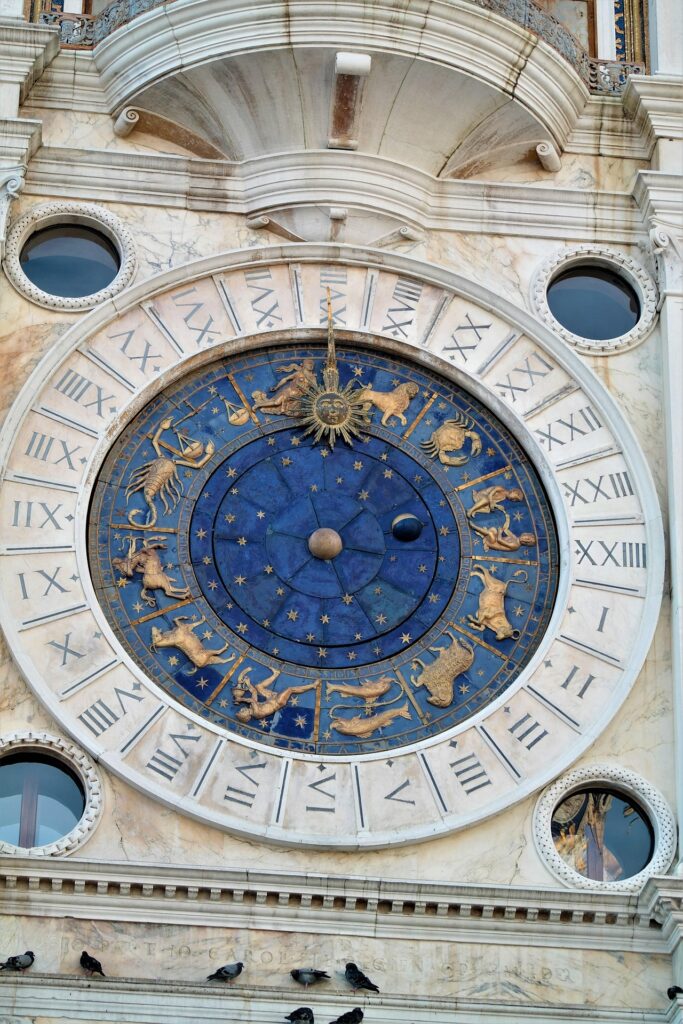
Lapis lazuli even finds its way into luxury watches and accessories. High-end watchmakers like Rolex, Piaget, and others have created limited-edition watches with lapis lazuli dials. In these pieces, a thin slice of top-grade lapis lazuli serves as the watch face, giving an opulent and unique look (each dial’s pattern of gold flecks is unique to that slice of stone).
A famous example is the Rolex Day-Date and Datejust models from the 1970s–1980s that featured lapis lazuli dial options – they are highly collectible today. Besides watches, lapis is also used in cufflinks, tie bars, and even as decorative knife handles or pen barrels, proving its versatility beyond typical jewelry.
- Carvings and Others
Though not worn, it’s worth noting that artisans often carve lapis lazuli into small sculptures, cameos, or intarsia mosaics for ornamental purposes. You might find a carved lapis Buddha, elephant, or scarab sold alongside jewelry in gemstone shops, or a tabletop inlaid with a mosaic of malachite, onyx, and lapis lazuli. These art pieces highlight how easily lapis can be shaped and how enduring its appeal is for decor.
When purchasing lapis lazuli jewelry, it’s wise to be aware of quality and authenticity (we will cover quality and price in the next section). Genuine, high-quality lapis has that unmistakable ultramarine blue color. Some sellers dye lower-quality lapis stones to enhance their blue, especially when the “denim” lapis looks very pale.
There are also imitations in the market, such as dyed howlite or jasper (other stones dyed blue with added pyrite-like flecks) and reconstructed lapis (small pieces of genuine lapis fused with resin). A reputable jeweler will disclose any treatments. Tiffany & Co., Cartier, and other luxury houses historically used only natural, top-grade lapis lazuli in their jewels, which is one reason vintage designer lapis lazuli jewelry can be quite valuable. The enduring presence of lapis in fine jewelry – from ancient Egypt’s treasures to Tiffany’s modern collections – attests to its permanent spot in the pantheon of desirable gems.
Quality, Value, and Care of Lapis Lazuli
Not all lapis lazuli is created equal. If you’ve ever seen various specimens side by side, you’ll notice a range from dull grayish blue stones with lots of white, all the way to electric royal blue pieces that look like a fragment of a midnight sky.
Quality
In lapis lazuli is primarily judged by color and purity of the stone. The most valuable lapis lazuli displays a uniform, intense dark blue color, sometimes called “Royal Blue” or “Afghan Blue,” with maybe a dusting of tiny golden pyrite inclusions. It has little to no white calcite visible. Stones like this, especially in larger sizes, are quite rare and command high prices.
In contrast, common-grade lapis (often from certain layers of a deposit or from less productive mines) can be a lighter or medium blue, with significant white calcite veins and only a little pyrite. This lighter variety is what’s known as denim lapis, as mentioned, since its blue is similar to faded jeans. While denim lapis can still be pretty, it’s less costly and often used in mass-market jewelry or craft projects.
Origin and Value
Historically, people considered Afghan lapis lazuli from Badakhshan the finest, and traders exchanged it for thousands of years. Even today, Afghan lapis that is top quality can be very expensive – large top-grade pieces can cost hundreds or thousands of dollars.
There are other sources of lapis lazuli, including the Chilean lapis mines (in the Andes, Chile) which started production in the 20th century. Chilean lapis lazuli tends to have more calcite, giving it a lighter blue with white patches, but good material can still be quite attractive.
In fact, lapis lazuli is the national gemstone of Chile, officially designated in 1984, and Chilean lapis has its own fans. Other notable sources are Russia (the Lake Baikal region in Siberia produces some fine dark blue lapis), Pakistan (neighboring the Afghan deposit), and smaller deposits in places like Myanmar and the USA. Generally, origin alone doesn’t determine price – it’s the look of the stone – but Afghan material dominates the high end of the market due to its quality.
Treatments and Imitations
When evaluating lapis lazuli, be aware of common enhancements. Because porous, lower-grade lapis can be dyed an artificial blue to improve its appearance. A dyed lapis might look too uniformly blue or might have a slight residue; jewelers often can tell by using acetone on a cotton swab (if it’s dyed, some blue color will come off).
Some lapis stones are also stabilized (impregnated with wax or resin) to improve luster and durability – this is generally an acceptable treatment as long as it’s disclosed. Complete fakes also exist: for example, “Swiss lapis” is actually a synthetic spinel that is colored blue to mimic lapis, and some glass or porcelain products with gold specks have been made to imitate lapis lazuli.
Another imitation is reconstituted lapis: small chips of genuine lapis are ground up, mixed with blue dye and resin, and formed into blocks that can be cut like a stone – technically it contains lapis, but it’s man-made in form. When you buy from reputable sources, you are less likely to encounter these, but it’s something to keep in mind, especially if a deal seems too good to be true. Natural, high-grade lapis is precious and priced accordingly.
Pricing
As of now, lapis lazuli price can vary widely. Tumbled pebble-sized pieces of ordinary lapis might be just a few dollars. A nice 1-inch lapis lazuli cabochon of deep blue could be $30–$50. Top gem-grade lapis in larger pieces can fetch significantly more – for instance, a strand of high-quality uniform lapis lazuli beads or a large carving could be several hundred dollars.
If the lapis has a historic or designer value (e.g., vintage Lapis Lazuli jewelry by Tiffany or a Rolex with lapis dial), the price goes into the thousands. Rarity also increases price: lapis lazuli with no calcite at all (all blue) and fine pyrite is uncommon. But the good news is that beautiful lapis lazuli is generally more affordable than many other gemstones of similar size. It offers a royal look without a princely sum, which is part of its enduring appeal.
Care and Maintenance
Taking care of lapis lazuli ensures that your blue gemstone retains its beauty for generations. Here are some care tips, given lapis lazuli’s specific properties:
- Avoid Chemicals and Acids
Lapis contains calcite, which is sensitive to acids. So you should avoid cleaners that are acidic (like vinegar, lemon juice) or harsh chemicals (like bleach, alcohol, or even commercial jewelry cleaners) on lapis lazuli. These can dull the polish or cause etching. Also, no perfumes or hairsprays should be applied onto lapis jewelry – put on such products before wearing your jewelry to minimize contact.
- Physical Wear
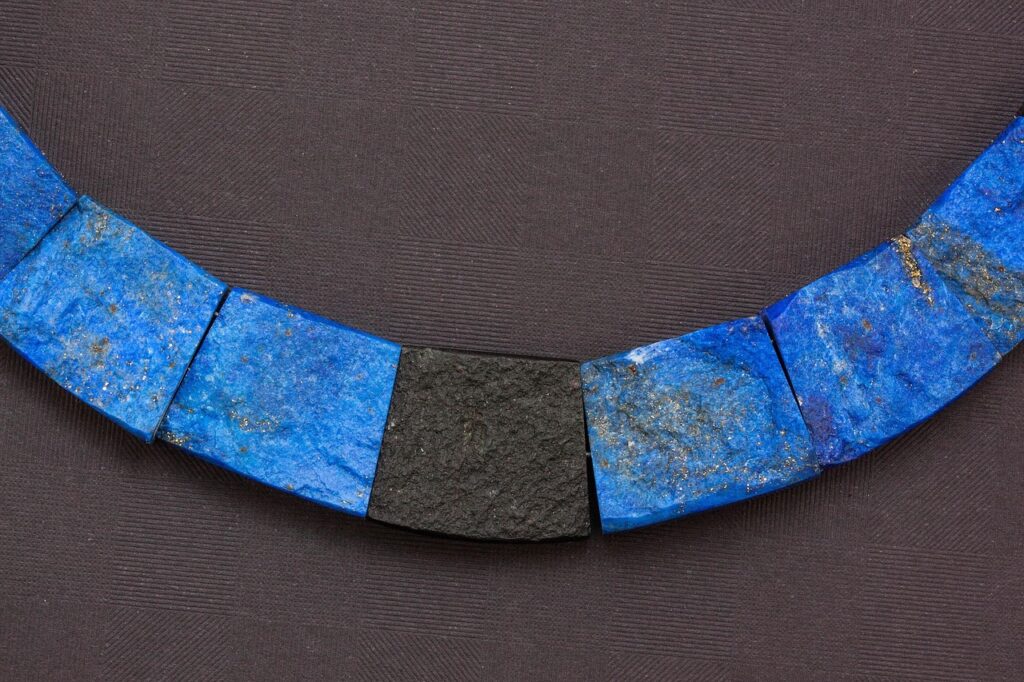
With a hardness around 5.5, lapis can get scratched by harder substances (which includes quartz, found in dust, and almost all other gemstones). So it’s wise not to wear your lapis lazuli ring or bracelet when doing housework, sports, or any activity where it might knock against surfaces. Even in storage, keep lapis lazuli pieces separate from harder stones like diamonds, sapphires, or even tossed in a box with random jewelry, as they could scratch the lapis. Using a soft pouch or lining a jewelry box compartment for lapis items works well.
- Cleaning
The safest way to clean lapis lazuli is with warm water, mild soap, and a soft cloth or brush. Gently wipe the stone; do not soak it for a long time, as water could penetrate if there are tiny fractures or the stone is porous. After washing, rinse with clean water and pat dry. Avoid extreme heat or ultrasonic cleaners, especially if the stone might be dyed or treated – heat and ultrasound can cause treated lapis to discolor or damage the structure. (Some natural, untreated lapis might handle ultrasonic cleaning, as one source notes, but since it’s hard to know if a stone was treated, it’s better to be cautious and stick to manual cleaning.)
- Polishing
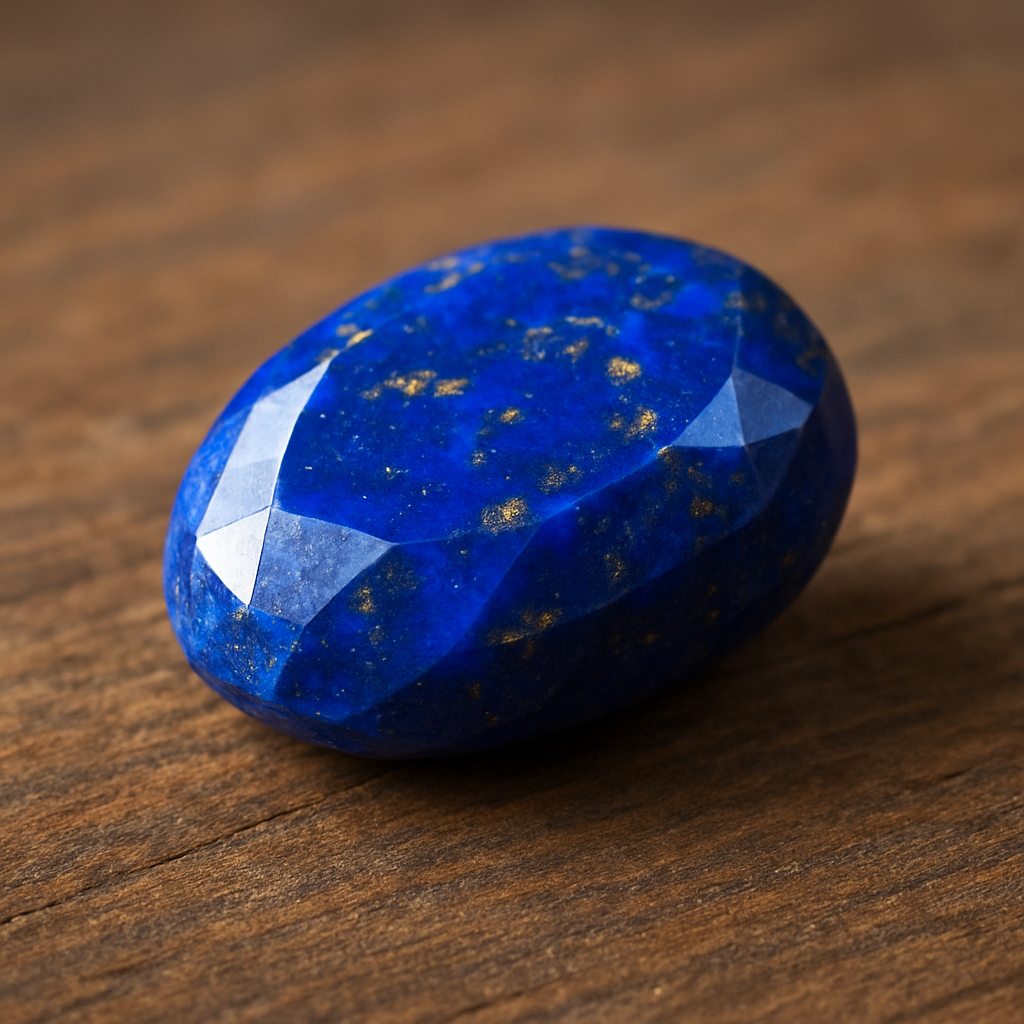
Over time, if a lapis lazuli piece loses its shine due to tiny scratches (looking a bit matte), a professional jeweler or lapidary can re-polish the surface to restore the waxy luster. This is a routine process for cabochons. You can also buff it gently with a jewelry polishing cloth for a quick touch-up, but avoid abrasive polishes.
- Avoid Excess Sunlight
This stone’s color is generally stable, but very prolonged exposure to intense sunlight might cause slight fading or drying of any oils in the stone. It’s a minor concern, but just store your lapis jewelry out of direct sunlight when you’re not wearing it.
When cared for properly, lapis lazuli ornaments and jewelry can last for many decades or even centuries – as evidenced by museum pieces of lapis from ancient times that still look vibrant. For example, the lapis inlays in Tutankhamun’s mask are over 3,000 years old and still retain their gorgeous blue. So with gentle handling, your lapis lazuli can truly be a timeless treasure.
Lapis Lazuli in Pop Culture and Modern Media
Beyond the world of gemology and history, lapis lazuli has made quite a splash in modern pop culture, proving that this ancient stone still captures the imagination of people in new ways. From cartoons and video games to literature, lapis lazuli’s legacy continues.
Steven Universe – “Lapis Lazuli” as a Character
One of the most prominent recent cultural references is in the animated TV series Steven Universe. In this popular Cartoon Network show, many characters are personified gemstones – and one of the recurring characters is named Lapis Lazuli.
This character, often just called “Lapis,” is an ethereal blue figure with water manipulation powers, reflecting the fluid, deep blue nature of the stone. She’s portrayed as both gentle and immensely powerful, having endured long periods of isolation (much like a gemstone trapped in rock for millennia).
The show has a large fanbase, and as a result, terms like “lapis lazuli Steven Universe” or “lapis lazuli SU” are commonly searched by those who discover the stone through the show. Interestingly, fans of Steven Universe often discuss the relationship between Lapis Lazuli and another character named Peridot – the two become friends (and roommates) in the series, and their contrasting personalities made them a beloved duo.
In fan communities, one might even see the phrase “Lapis Lazuli x Peridot” indicating art or stories that pair the two characters together. The inclusion of Lapis Lazuli in this show has introduced a younger generation to the gemstone, sparking interest in its real-world properties and even in lapis lazuli jewelry inspired by the character (like cosplay or themed accessories). It’s a great example of how a cartoon can elevate a gemstone’s profile.
Minecraft – Mining Lapis Lazuli
In the world of video games, lapis lazuli is famously featured in Minecraft, one of the best-selling games of all time. In Minecraft, lapis lazuli appears as a minable ore block deep underground. When players mine lapis lazuli ore, it drops pieces of “lapis lazuli” (as an item) which are bright blue lumps.
These are then used as a blue dye to color materials (fitting, since real lapis was used as dye/pigment historically), and more importantly, lapis lazuli is a required resource for enchanting items in the game. To enchant a weapon or tool in Minecraft, you need to place the item in an enchanting table along with a certain number of lapis lazuli pieces to fuel the enchantment. Because of this, players value finding lapis in their Minecraft worlds to improve their gear.
The phrase “lapis lazuli Minecraft” is thus commonly associated with guides on how to find and use it in the game. The inclusion in Minecraft is another nod to how ingrained lapis is in the idea of a valuable blue resource – even in a virtual world, the concept carries through that lapis is something precious and magical.
Sekiro: Shadows Die Twice – Rare Upgrade Material
Another video game to feature lapis lazuli is Sekiro: Shadows Die Twice, an action-adventure game by FromSoftware. In Sekiro, Lapis Lazuli is depicted as an extremely rare material needed to perform the final upgrades on the protagonist’s prosthetic tools. Players can only obtain a handful of lapis lazuli in each playthrough of the game, making it as valuable in the game’s context as it was in ancient times.
It’s essentially the endgame upgrade component – the developers likely chose it for its historic connotation of rarity and value. The game describes it as a “precious azure lazulite” and indeed treats it like a mystical stone. Gamers often look up “lapis lazuli Sekiro” to find out how to collect all the pieces. For instance, you need Lapis Lazuli to fully upgrade powerful tools, and only six pieces are obtainable per playthrough (requiring a second playthrough to get enough for everything). This difficulty echoes the stone’s elusive nature and adds to its mythos in the game world. So, lapis lazuli here represents the pinnacle of achievement, much like a treasure.
Other References
Lapis lazuli has popped up in various other cultural niches. It’s been mentioned in literature and poetry (notably in a poem titled Lapis Lazuli by W.B. Yeats, symbolizing art and enduring civilization). It also appears in Dungeons & Dragons and other fantasy games as magical components or treasure. In the realm of luxury, as mentioned, a Rolex or other high-end watch with a lapis dial is a status symbol – sometimes making cameos in movies or celebrity collections. And historically, lapis lazuli was ground to make the pigment for Maya blue and other cultural artifacts, which occasionally gets a nod in documentaries or historical novels.
This gemstone even influences color naming in fashion and design – you might find dresses or paints described as “lapis lazuli blue,” capturing that deep, vibrant blue that the stone embodies. Indeed, lapis lazuli color has become shorthand for a particularly rich medium blue.
All these instances show that lapis lazuli, far from being a relic of ancient history, is very much a part of our contemporary cultural fabric. Whether through a beloved cartoon character, a pivotal video game item, or a piece of fine art, the stone continues to inspire and fascinate.
The Enduring Allure of Lapis Lazuli
From the deepest mines of ancient Afghanistan to the digital realms of modern video games, lapis lazuli has journeyed through human history as a constant source of inspiration and admiration. Its meaning has evolved from a divine stone of gods and kings to a personal talisman of wisdom and truth. Yet, at every step, people have been drawn to its blue beauty and the almost mystical presence it carries. Kings, emperors, artists, and spiritual seekers – all have fallen under the spell of lapis lazuli’s charm.
World of Lapis Lazuli Jewelry
In the world of jewelry, lapis lazuli remains a beloved choice, offering a classic yet bohemian vibe that can be both luxurious and down-to-earth. A piece of lapis lazuli jewelry, be it a necklace, bracelet, or ring, is not just an accessory; it’s a tiny slice of human heritage and Earth’s art. Wearing lapis lazuli can feel like wearing a piece of starry night sky or a fragment of an ancient artifact rediscovered – it bridges the past and present in a beautiful way.
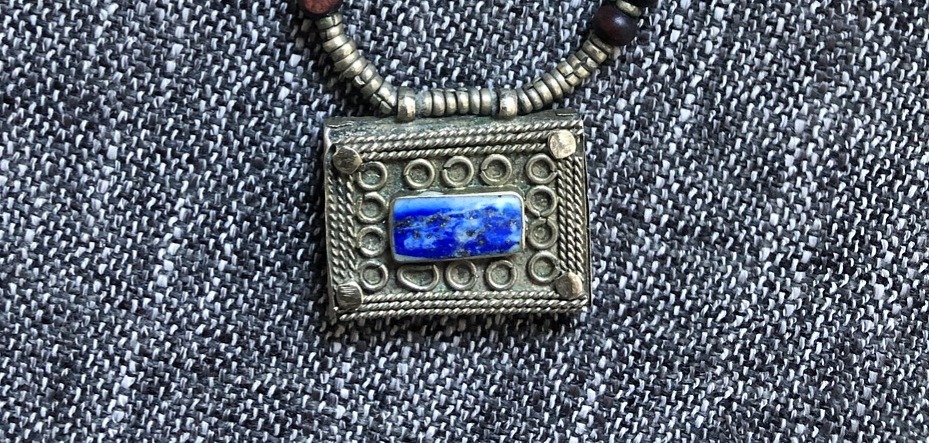
For anyone enchanted by the color blue or intrigued by gemstones with rich backgrounds, lapis lazuli is a must-have in a collection. It’s affordable enough that you don’t have to be a pharaoh to own it, yet it carries the gravitas of a gemstone that once adorned pharaohs.
Whether you appreciate it for its historical significance, its metaphysical properties, or simply its eye-catching looks, lapis lazuli certainly earns its reputation as a legendary blue gemstone. Like the wisdom it symbolizes, its allure only grows deeper with time, ensuring that lapis lazuli will continue to shine brightly in human culture for many ages to come.
As we have seen, all these aspects and more form the incredible tapestry of facts and stories around this remarkable blue gem. Embracing lapis lazuli is like holding a piece of history and imagination in the palm of your hand. Enjoy the magic of this stone, and let its blue inspire you!
Frequently Asked Questions about Lapis Lazuli
What does lapis lazuli do?
Lapis lazuli is known as a stone of wisdom and truth. Spiritually, it is believed to promote inner peace, strengthen intuition, and open the throat chakra for clear communication. In jewelry, its deep-blue color with golden flecks symbolizes confidence, self-expression, and timeless style.
Is lapis lazuli real?
Yes. Lapis lazuli is a natural rock composed mainly of lazurite, calcite, and pyrite, which gives it its famous deep blue with golden flecks. It has been mined and prized for over 6,000 years.
Is lapis lazuli expensive?
It is generally more affordable than precious gems like sapphire or emerald, but price depends on color and quality. The most valuable lapis shows a rich, uniform deep blue with minimal white calcite and fine pyrite; lighter or uneven stones cost less.
What does lapis lazuli mean?
The name means “blue stone” (from Latin and Persian roots). Historically it symbolizes wisdom, truth, and royalty, and is associated with protection, clarity of mind, and spiritual insight.
What is lapis lazuli used for?
Primarily jewelry—rings, necklaces, earrings, and bracelets—where its deep blue makes a bold statement. It is also used for carvings and decorative art. Spiritually, many use it for meditation, chakra work, and protection to encourage truth, wisdom, and emotional balance.
How much is lapis lazuli worth?
Value depends on color, purity, and quality. High-grade stones with deep royal blue and fine pyrite can range from about $40 to over $100 per carat. Lower-quality stones with pale blue or abundant white calcite are much less expensive.
Where does lapis lazuli come from?
Historically and today, the finest material comes from Sar-i Sang in Badakhshan, Afghanistan. Other notable sources include Chile, Russia (Lake Baikal), Pakistan, Myanmar, and smaller deposits in the USA. Color and purity drive value more than origin.
What does lapis lazuli look like?
It is an opaque, deep-blue gemstone often sprinkled with golden pyrite flecks and sometimes white calcite streaks or patches. Top quality shows a rich, uniform royal or ultramarine blue with minimal white and fine, sparkling gold.
What does lapis lazuli symbolize?
It symbolizes wisdom, truth, and royalty, historically linked with the heavens, justice, and spiritual insight. Today it’s also associated with inner peace, clarity, honest communication, friendship, and harmony.
Where is lapis lazuli found?
Mainly in Afghanistan’s Sar-i Sang mines, the world’s oldest and most renowned source. Other deposits occur in Chile, Russia (Lake Baikal), Pakistan, Myanmar, and the USA; Afghan lapis is generally considered the finest.
Sources:
Lapis Lazuli Symbolism – International Gem Society
Lapis Lazuli: Crystal Properties, Origins and Uses | HowStuffWorks
Lapis Lazuli – Minecraft Wiki